 Stach Care
 How to Grow an English Mustache: The Complete Guide
Long, narrow, and pulled straight out to the sides like the wings of a very dignified aircraft. The English mustache is all about length and discipline. Here is the plan.
The English mustache is the handlebar's stiff-upper-lip cousin. Where the handlebar curls, the English goes straight out, horizontally, into long tapered points that extend well past the face. It is narrow at the center, grown long at the ends, and styled with enough wax to keep a perfectly level line. It is the mustache of RAF wing commanders, Hercule Poirot, and a surprising number of world championship winners. It takes time, and it takes a steady hand.
What It Is and Who It Suits
An English is a long mustache with the hair on either side of the philtrum (the groove under your nose) kept narrow and the ends grown long, combed outward, and waxed into straight horizontal points. The areas beyond the corners of the mouth are usually shaved clean so the wings appear to float.
It suits oval, oblong, square, and diamond faces. The strong horizontal line adds width, which is excellent on long faces and helps balance a narrow chin. Round faces should think twice; the English makes faces wider, not longer.
Growth requirements: this is a length style. You need hair at the corners that grows long and reasonably straight. Curly mustache hair can be trained with wax but fights you every morning.
Growth Timeline
Weeks 1–2. Stubble. Leave it all.
Weeks 3–4. Awkward stage. Comb outward from the center every morning; you are training the hair to go sideways, which it does not naturally want to do. Trim only the hairs entering your mouth.
Weeks 5–8. The ends clear the corners of the mouth. Apply a medium wax and pull the ends straight out for the first time. Narrow the center: trim the lip line and shape the body so it tapers from the middle toward the wings. Shave the skin beyond the corners of the mouth.
Weeks 8+. From three months on, the wings get long enough to hold a true horizontal line. A competition-length English takes six months to a year. Most wearers settle at a pleasant four-month length where the points extend an inch or two past the face.
Tools You Need
- A firm mustache wax; the English needs real hold (wax guide)
- A fine-tooth comb
- Sharp scissors and a detail trimmer
- A hair dryer to set the wings
- A small brush for the body
- Patience measured in seasons
How to Trim and Shape It
- Wash and dry. Comb from the philtrum straight out to each side.
- Trim the lip line so the top lip is visible; the English is neat at the center.
- Taper the body: it should be slightly thinner at the center than at the corners, so the wings look like they grow from one continuous line.
- Shave the cheeks and the skin beyond the corners of the mouth, so the wings float free.
- Check wing length symmetry by looking straight on. Trim the longer wing to match. Never trim both.
- Leave the tips alone otherwise. Length is the whole point.
Styling and Wax Technique
Warm a pea of firm wax. Work it through from the center outward. At the wings, pinch the hair between thumb and forefinger and draw it straight out, parallel to the floor, twisting very slightly to form a tapered point. Do not curl up; do not let it droop. Set with a hair dryer on low, then cool. Some wearers use a second, tiny application just at the tips for a crisper point.
If the hair wants to curl, comb it out again while the wax is warm and pull firmly; repeated daily styling trains it straighter over weeks.
Common Mistakes
- Letting the wings curl up. That becomes a handlebar. Keep them level.
- Letting the wings droop. Not enough wax, or wax that is too soft.
- Keeping a thick center. A full chevron body with long wings is a different look; the English tapers.
- Trimming the tips for "neatness." You just lost a month.
- Skipping the cheek shave. The floating wings are the signature; stubble under them muddies the line.
Variations Worth Knowing
The everyday English keeps the wings an inch or two past the face and slightly tapered. The competition English stretches them as far as the hair will allow, held dead level with firm wax. The "Poirot" is short, narrow, and impeccably tidy, more about precision than length. A thicker body with long wings is sometimes called an English chevron; it is a softer look that suits people whose center growth is too dense to taper. Pick a length goal early and plan your wax and trimming around it.
Famous Wearers
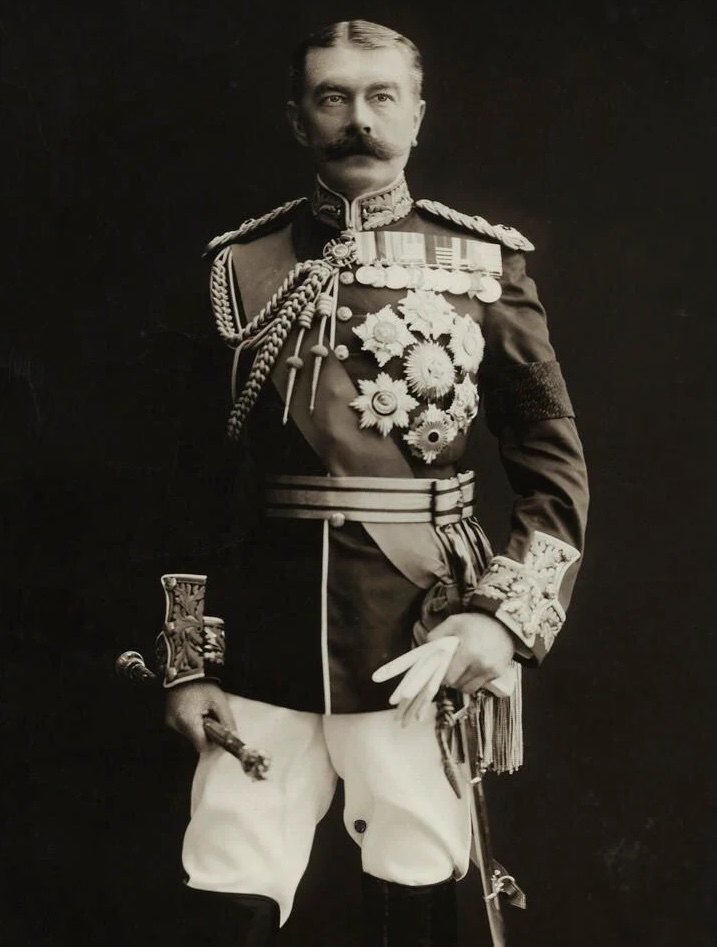
Lord Kitchener wore the most famous English mustache in history, pointing at an entire nation from a recruiting poster. Karl-Heinz Hille won world championships with one. David Suchet's Hercule Poirot kept it impeccably groomed, and Terry-Thomas used it for comedy. It remains the dominant style at the World Beard and Moustache Championships.
How to Maintain It
Wash and condition every day or two, oil the length to prevent breakage, comb out each morning, wax for the day, wash out at night. Shave the cheeks daily. Trim the lip line every two weeks. The English is high maintenance, but it is also the style most likely to get you stopped on the street for a photo.
Mr. Stach grooming content is educational and not medical advice.
Grooming content is educational and not medical advice.
Frequently Asked Questions
How long does it take to grow an English mustache?
Around three months for the wings to hold a horizontal line with wax, four months for a good everyday length, and six to twelve months for competition length.
What is the difference between an English and a handlebar mustache?
The English pulls the ends straight out horizontally into tapered points. The handlebar curls the ends upward into loops.
How do I stop my English mustache from curling?
Use a firm wax, pull the ends straight out while the wax is warm, and set with a hair dryer. Daily styling trains the hair straighter over time.
Should I shave under the ends of an English mustache?
Yes. Shave the cheeks and the skin beyond the corners of the mouth so the wings appear to float. It is the signature of the style.