 Mustache History
 Military Mustaches: How Armies Made the Stach Go Global
Hussars, grenadiers, the British Army's compulsory mustache and the clean-shaven turn of the World Wars. The military did more than any other institution to spread and then retire the mustache.
If you want to understand why the mustache is everywhere in nineteenth-century portraits and nearly absent from the twentieth, look at the army. For roughly two hundred years, military fashion set the pace for civilian faces, and the mustache was at the center of it.
Cavalry swagger
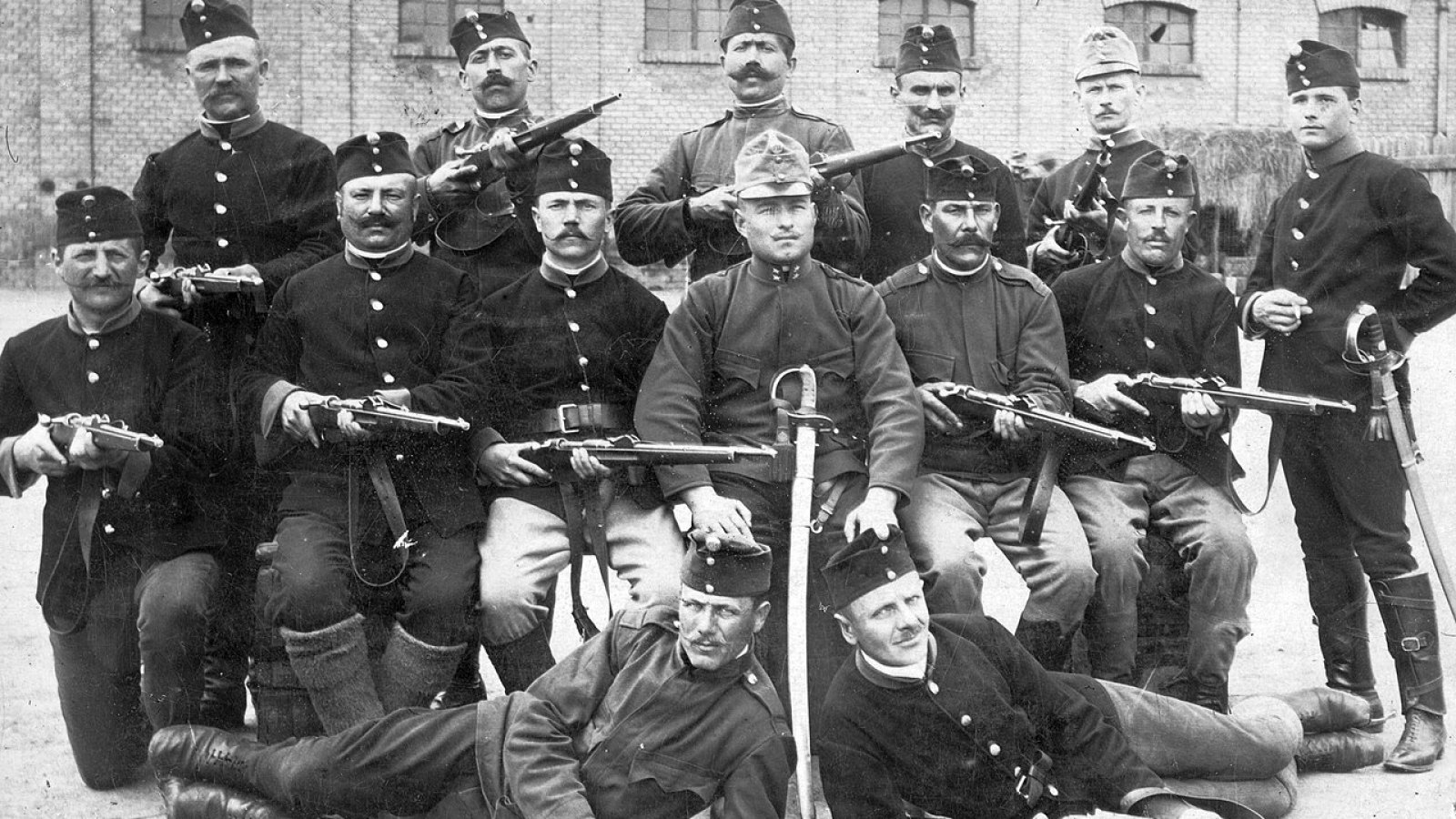
The modern military mustache traces back to European cavalry of the 1600s and 1700s. Hungarian hussars, light cavalry famous for their flamboyant uniforms, wore long, often waxed mustaches as part of their look. When other European powers raised their own hussar regiments, they imported the uniform and the mustache along with it. French, Prussian, Austrian and British light cavalry all came to associate the mustache with dash and daring.
Grenadiers, the tall shock troops of the line infantry, were frequently encouraged or required to wear mustaches as well. The logic was partly intimidation and partly identity: a unit that looked fierce and looked the same projected discipline.
Napoleon's influence
The Napoleonic Wars turned the mustache from a cavalry quirk into a continental standard. French soldiers of many branches wore mustaches, and the European armies that fought them, and copied them, followed suit. Prussian and Austrian troops, Russian officers and British dragoons all adopted the look during and after the wars. In some armies, soldiers who could not grow a satisfactory mustache were reportedly issued or expected to apply artificial ones for parade. Whether or not that practice was widespread, the fact that the story circulated tells you how seriously regiments took the uniform face.
The British Army makes it mandatory
The clearest example of military mustache policy comes from Britain. British officers serving in India in the early nineteenth century adopted mustaches partly because, in local culture, a bare upper lip could be read as youthful or unserious. Back in Britain the fashion spread, and from 1860 until 1916 the King's Regulations stated that the upper lip was not to be shaved. The mustache was, in effect, compulsory for British soldiers for more than half a century.
The rule was dropped in October 1916, in the middle of the First World War. The reasons were practical. Many new recruits were very young and could not grow a convincing mustache, and the policy had become an annoyance. The order was signed by Lieutenant General Sir Nevil Macready, who, by his own account, disliked his own mustache and shaved it off the moment the rule changed.
The world wars and the clean shave
The First World War also introduced a reason for the mustache to retreat that had nothing to do with taste: the gas mask. Early respirators needed a tight seal against the face, and facial hair interfered. Armies that had spent a century promoting the mustache now had a safety argument against it. Many men kept a trimmed mustache that stayed clear of the seal; beards largely vanished from the front line.
Across the Atlantic, the United States Army took a different path. American military culture had tolerated substantial facial hair during the Civil War, when generals on both sides wore beards of every description, but by the early twentieth century the preference shifted toward a clean, uniform appearance. A trimmed mustache remained permissible, and the most famous American military mustache of the period belonged to General John J. Pershing, commander of the American Expeditionary Forces in 1917 and 1918. His neat, clipped mustache gave its name to a style still called the Pershing.
Regulation, relaxation, regulation
The back-and-forth of the twentieth century followed a pattern. Periods of relaxed standards, such as the early 1970s when the U.S. Navy under Admiral Elmo Zumwalt briefly permitted beards, were followed by tightening. The mustache, neat and trimmed, was usually the one piece of facial hair that survived each round of regulation, because it could be worn without interfering with equipment and without looking unkempt.
Today most Western militaries permit a neatly trimmed mustache within defined limits and prohibit beards except for medical or religious accommodation. The mustache is the compromise that two centuries of regulation settled on, and it is why you can still see one on a parade ground when you will rarely see a beard.
The legacy
Every time a civilian grows a mustache "like a soldier," he is echoing a specific history: hussars in Hungary, dragoons in India, a regulation signed in 1860 and repealed in 1916, and a general named Pershing. We cover that regulation history, and the Pershing style itself, in more detail in our military section.
Frequently Asked Questions
Was the mustache ever mandatory in the British Army?
Yes. From 1860 to 1916, King's Regulations stated that the upper lip was not to be shaved, making the mustache effectively compulsory.
Why did military beards decline during World War I?
Gas masks required a tight facial seal, and facial hair interfered. Trimmed mustaches that stayed clear of the seal remained common.