 Mustache History
 Wild West Mustaches: Lawmen, Outlaws and the Frontier Lip
Wyatt Earp, Bat Masterson, Bass Reeves and the mustache as frontier uniform. The real story behind the most photographed facial hair in American history.
Ask someone to picture the Old West and they will picture a mustache. The image is so fixed that it is easy to forget it is also accurate. In the decades after the Civil War, the men who policed, robbed, gambled in and photographed the American frontier wore mustaches at a rate that would embarrass a modern Movember campaign.
Why the frontier grew a mustache
The simplest answer is that everyone did. The Wild West period, roughly 1865 to 1895, coincides almost exactly with the Victorian golden age of facial hair. Men arriving in Dodge City or Tombstone brought the fashions of the East and of the army with them. Many were veterans of the Civil War, where facial hair had been the norm on both sides.
There were practical arguments too. Shaving on the trail was a nuisance, water was scarce, and a mustache required less upkeep than a beard while still looking respectable in town. And in a world where a man's reputation was his main asset, a full mustache signaled maturity and seriousness. Many of the famous lawmen were in their twenties and early thirties at the height of their careers; the mustache made them look older.
The lawmen
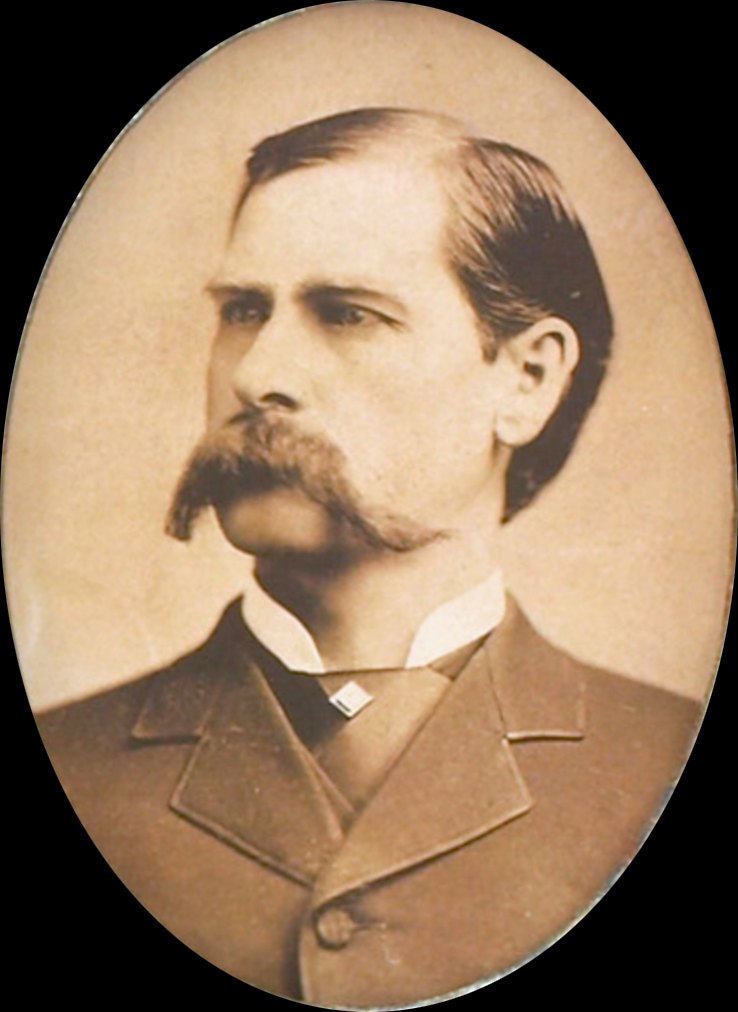
Wyatt Earp (1848–1929) is the best known. Photographs from the 1880s show a long, thick, drooping mustache that covered his upper lip completely, a style now generally classed as a walrus or a heavy chevron. Earp's look was so distinctive that nearly every actor who has played him, from Henry Fonda to Kurt Russell, has grown or worn a version of it.
Bat Masterson (1853–1921) wore a neater, more urbane mustache, in keeping with his later career as a New York sportswriter. Masterson was a buffalo hunter, army scout, Dodge City lawman and gambler before he ever picked up a pen, and his photographs show a man who took care with his appearance.
Bass Reeves (c. 1838–1910), one of the first Black deputy U.S. marshals west of the Mississippi, served for more than three decades in Indian Territory and is credited with thousands of arrests. The surviving photographs show a substantial, well-kept mustache. Reeves has become a focus of renewed historical interest in recent years, and his mustache is part of a legend that is finally getting the attention it deserves.
Frank Hamer (1884–1955) came a generation later, but his long career as a Texas Ranger, including leading the 1934 pursuit of Bonnie and Clyde, makes him the bridge between the frontier lawman and the modern one. Hamer's mustache was trimmer than Earp's, reflecting the changed fashions of the twentieth century.
The outlaws and the gamblers
Facial hair was not a badge of office. The men on the other side of the law wore the same mustaches. Gamblers such as Doc Holliday were photographed with carefully groomed mustaches, and the cowboys and rustlers who drifted through the cattle towns were as hairy as the marshals who arrested them. On the frontier, the mustache was less a statement of allegiance than of belonging to the time and place.
The photograph and the legend
One reason the Wild West mustache is so fixed in memory is that the period coincided with the spread of portrait photography. Studios operated in even small frontier towns, and lawmen, soldiers and outlaws alike sat for formal portraits. Those photographs, reproduced endlessly in dime novels, newspapers and later in films, froze the look of the era. Hollywood then reinforced it for a century, so that the mustache became a shorthand: a man in a wide hat with a heavy mustache is a Western character before he says a word.
What it means today
The Wild West mustache is the ancestor of the modern horseshoe and walrus, and of the whole idea of the "lawman stache" that we cover in our law enforcement section. It is also a reminder that the mustache has always been more about time and place than about good guys and bad guys. In 1881, in Tombstone, Arizona, everyone at the O.K. Corral had one.
Frequently Asked Questions
What style of mustache did Wyatt Earp wear?
Photographs from the 1880s show a long, thick, drooping mustache usually described as a walrus or heavy chevron.
Who was Bass Reeves?
One of the first Black deputy U.S. marshals west of the Mississippi, who served more than thirty years in Indian Territory and is credited with thousands of arrests.