 Military Staches
 Why the Mustache Endured in Service
Beards came and went. Long hair came and went. Through two centuries of changing regulations, the mustache stayed. Here is why.
Military grooming standards have swung back and forth for two hundred years. Beards have been required, permitted, prohibited and permitted again. Hair length has risen and fallen with the decades. But through nearly all of it, in nearly every Western military, one thing has remained: the option of a neatly trimmed mustache. This article looks at why the mustache endured when so much else did not. It is a historical and cultural discussion, not a statement of any service's policy.
It fits the equipment
The first and most practical reason is equipment. Since the First World War, respiratory protection has been a fact of military life, and tight-fitting masks need a seal against the skin. A beard breaks the seal. A mustache trimmed so that it stays above the lip line and inside the corners of the mouth generally does not, because the mask's sealing surface runs across the nose, cheeks and chin rather than across the upper lip. That geometry is the single biggest reason the mustache was allowed to stay when the beard was not. It was never primarily about taste. It was about where the rubber met the face.
It fits the inspection
The second reason is that the mustache can be regulated precisely. Grooming standards thrive on measurable rules, and a mustache lends itself to them: not below the lip line, not beyond the corners of the mouth, neatly trimmed, no exaggerated length. A sergeant can check a mustache in a glance. Beards are harder to define and police, which is one reason services that have relaxed beard rules have often had to write detailed standards for them. The mustache, by contrast, has had a stable definition for a century.
It carries tradition
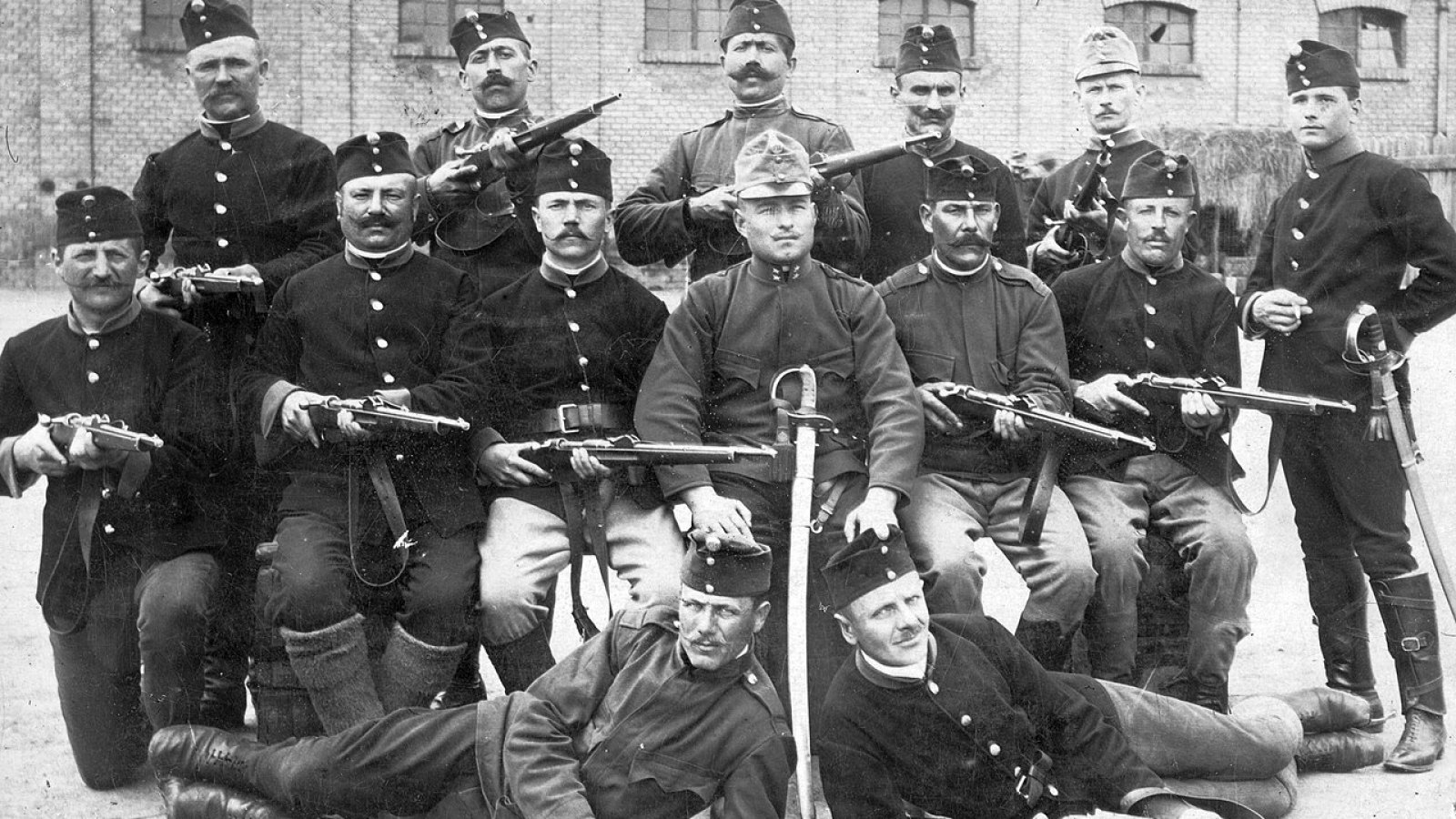
The third reason is cultural. The mustache entered military life in the cavalry regiments of the eighteenth and nineteenth centuries and became associated with courage, experience and professional soldiering. The British Army required it for more than fifty years. Continental armies made it a regimental norm. American generals from the Civil War through Pershing wore it. That history gave the mustache a legitimacy inside military institutions that the beard, associated with irregulars and with the civilian counterculture of the 1960s and 1970s, did not have. When a service considered tightening standards, the mustache had history on its side.
It marks the senior man
Within units, the mustache took on an informal meaning that regulations did not create but did not discourage. A well-kept mustache came to be associated with the experienced noncommissioned officer, the senior pilot, the chief. It was not a rule, and plenty of senior men were clean-shaven, but the association was real and it was self-reinforcing. Young service members saw the mustache on the people they respected and grew their own when they could. That informal transmission kept the tradition alive through periods when fashion outside the gates had moved on.
It survived the swings
Consider what the mustache outlasted. The British compulsory rule ended in 1916; mustaches stayed permitted. The World Wars favored the clean shave; mustaches stayed permitted. The U.S. Navy allowed beards under Admiral Zumwalt in 1970 and withdrew that permission in the 1980s; mustaches were untouched at both ends. Religious and medical beard accommodations expanded in the twenty-first century; mustaches were, again, unaffected. In each swing, the mustache was the constant. That is not an accident. It is the result of the mustache being the one option that satisfied equipment, inspection and tradition at the same time.
The veteran's mustache
The tradition does not end at discharge. Many veterans keep the mustache they wore in service, and for some it becomes a lifelong marker of that chapter. Others grow it out after leaving, adopting styles that were not available to them in uniform, which is its own kind of tradition. Veterans' organizations, reunions and memorial events are full of mustaches, and the look connects men across generations of service in a way that few other things do.
Respectfully
None of this is meant to glamorize. Military grooming standards exist for reasons of safety, discipline and uniformity, and they are set by the services, not by this site. What we can say, as people who take the mustache seriously, is that its endurance in military life is a genuine piece of history: a small tradition that lasted because it worked, and that continues to connect the people who wear it to a very long line of those who came before.
Frequently Asked Questions
Why are mustaches allowed in the military when beards usually are not?
A neatly trimmed mustache stays clear of the sealing surface of protective masks, is easy to regulate precisely, and carries long institutional tradition.